The Zierenberg Sonata
By Quinten van den Broeck (English)
1/28/2026
I thought I already knew a thing or two about dreams; about how you can dream your life and then go on to live those dreams. For a year and a half I had traveled through South America, following nothing but my own desires and longings. To learn how to dream again, you first of all have to be free. And for that, you need to spend a lot of time with yourself. Free yourself from all the expectations others have consciously or unconsciously imposed on you. Slowly, in that silence, your deepest soul’s desires begin to bubble up. They start small, but grow as you feed them. Until, at some point, you begin to fulfill dreams you never thought possible. And when you start living those kinds of dreams, life itself begins to feel like a dream. Nothing is coincidental anymore; everything seems to move along with you. You are the undisputed main character of your own life. The universe works with you.
Charlotte told me about her dream. Together with an Iranian musician, she had submitted a proposal for a wind art festival somewhere in Germany. It was to be a bamboo temple that would whistle in the wind. I knew nothing about bamboo, and even less about whistling. And the only wind art I make are the very loud, drawn-out farts I can produce on particularly blessed days. But I was intrigued by her philosophy. Spending time building in the elements. Connecting with the landscape. Bringing people together consciously. Creating something together, without pressure, playfully, inviting everyone to be themselves and to put something of themselves into the project. It promised to be an experiment in anarchistic organization. I was sold. I decided to follow a dreamer and ended up in a dream. And that’s how I learned that you can also dream together and that those dreams can be just as intense, wondrous, and mysterious as the big dreams I had come to believe either push people away or suffocate them.
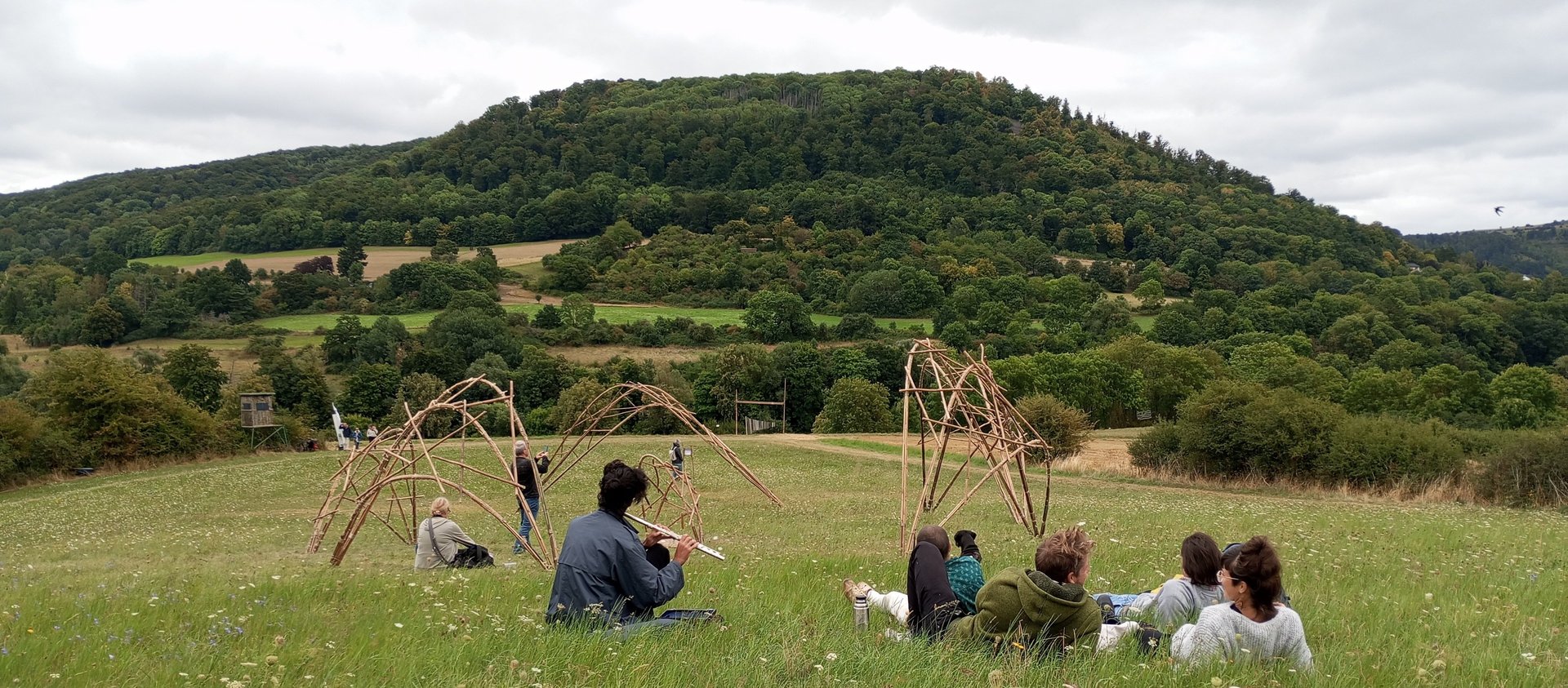
The wind art festival took place in Zierenberg. A picturesque village in central Germany, located in an idyllic valley surrounded by hills and forest. The hill on which we would build our bamboo temple was magnificent. A rolling flower meadow bathed in sunlight, an old willow tree offering shade, a volcanic hill from behind which the moon would appear in the evening, and down in the valley, Zierenberg, calm and timeless, dominated by its sturdy church tower. This hill became our sanctuary. Here we would build our temple while letting our skin tan under the sun. Here our souls would touch.
Ali had developed the project around a poem by Rumi. He had grown up with those poems. He had fled from Iran to Belgium to avoid military service. He suffered greatly from homesickness and was also dealing with a broken heart. Perhaps that’s why he chose the poem about the reed bed, a poem about uprooted reeds crying in the wind, longing for the lost safety and unity of the reed bed from which they were harvested.
Ali was there when we went to harvest the bamboo in Belgium. He was late, and when he finally arrived it was as if he carried the weight of the world on his shoulders. But as he worked with us, wrapped in his melancholic silence, stripping the harvested bamboo of leaves and twigs with long strokes of his machete, something in him changed. As if he had polished not only the bamboo, but also his soul during that meditative, monotonous labor. He had been paralyzed by doubt. One day of wholesome work on a sun-drenched summer day had cleared the fog in his mind.
The doubt was still strong during those first few days on the hill. Ali had taken the initiative, discovered this strange art festival, and convinced Charlotte to submit a proposal with him. But Charlotte was the driving force that had brought us to Zierenberg. It was she who had gathered a team of volunteers, drawn the plans, and solved the logistical puzzles to turn the concept into a project. The contrast in energy could hardly have been greater.
Charlotte full of passionate conviction, her doubts hidden from everyone; Ali despondent and consumed by despair, wondering out loud whether there would be enough wind to make his bamboo-carved flutes sing. An amusing duet between an insistent flamenco guitar and a hesitant bassoon.
But on the third day, the day the full moon broke through the clouds, we heard the flutes sing for the first time. Something essential shifted in that moment. I witnessed Charlotte and Ali sitting side by side among the forest of bamboo flutes. How it began to sing when a strong evening breeze arose. How it sounded exactly like the lament of reeds longing for their motherly reed bed. How perfectly it expressed Ali’s feelings of melancholy and longing. And how brightly the moon shone from behind the fast-moving veils of clouds. A cloud in the shape of an eagle. An owl calling in the distance and a tender conversation between two friends. Two reeds from another reed bed, uprooted, finding a bit of home in each other in a moment forever etched into the soul.
I was a witness to all of this, and I swear: what happened there was nothing less than pure alchemy, the alchemy of the soul; the merging of two souls that lift each other up, transforming into something more. Charlotte, the radiant moon giving Ali the courage to sing his song. Ali’s song teaching the moon to feel again. Two artists forging friendship into art and art into friendship. Two people making each other more human.
The bamboo temple consisted of six domes, each dome made of three arches. Six domes for six people: Charlotte, Ali, Lucas, Silas, Mattijs, and myself. Just like the six people, the six domes each had their own personality. They were not only harvested, tied, and bent with our own hands, they were also impregnated with meaning through the moments we created around and beneath them.
The first dome was named Slightly Stupid. It was less round than the others. There was a bit of a kink in it. It came to symbolize those first hesitant evenings of getting to know each other, the emergence of the first inside jokes - slightly stupid - the light, self-deprecating silliness that gave everyone the space to be themselves.
The idea of the temple was that the domes move in a spiral toward a center: the eye of the storm. And just as the storm intensifies the deeper you go into it, so too did the moments we shared in and around the newly built domes grow deeper and more intimate over the days.
The second arch was completed on the day of the full moon. Her name became Luna. At sunset, Ali played his transverse flute beneath her arch. The rest of us watched in awe. It began to dawn on us what an unbelievably beautiful place this Zierenberg was, and what powerful magic was unfolding here.
Under the third arch we had a party. It was here that Charlotte gave us our T-shirts. It was the birth of her company. Of nest.
It was also the first evening we looked through Mattijs’ telescope. We saw the moon in all her rugged glory. We saw Saturn with its ring and its moons. I saw Iapetus, an icy moon wandering through the vast nothingness three and a half million kilometers away. And we also found the Hercules cluster: a collection of two hundred galaxies, 25,000 light-years away from us.
We looked long and far into the bottomless depths of the universe and discovered that the more you learn to look, the more stars you see. The same principle applies to people: the longer and more attentively you keep looking, the more human, the more beauty you see.
The flowers on our hill also seemed to increase in number every day. Day by day I became more aware of the wind. How it made the blades of grass and flowers sway, almost dance. How it caressed my skin, made the leaves of the trees rustle, each leaf its own story, its own sound.
On a scorching hot day we sought shade under the wide crown of the old willow tree. Grateful for the shelter it gave us, we admired this mysterious being. Silas explained how trees do not grow from the ground, but from the air. That they consist for more than eighty percent of carbon they extract from the air by breaking down the carbon dioxide carried to them by the wind. It was the first time I realized that trees are made of air and sunlight. The longer I live in this world, the more I feel like I understand nothing, as if I’m in the middle of a long-winded, absurd joke that is being invented as it’s told, and whose punchline keeps eluding me.
And while we sat there together in the shade beneath its branches, this old willow, this creature of the wind, witnessed how Ali descended like a prophet of the hill, joined us, and read each of us a poem by the Sufi mystic Hafez. Each poem a reminder of who we have always been and what we came to do in this life. An appeal to the truth we already knew because it lives within us.
The fourth dome was raised on the eve of the night when the Perseid meteor shower was at its peak. It was the warmest day of our German summer and we spent the night under the open sky. The dome was our canopy bed. The flutes were attached between the different arches in such a way that they mirrored the constellation Cassiopeia. We saw more shooting stars than we had wishes. The overwhelming richness of the moment had overtaken our desires. The world was perfect, if only for a while.
And so the days drifted by. From one moment of perfect togetherness to the next. Starting the day together by doing the dishes, making coffee, buying bread, preparing breakfast… It was as if every mundane action became richer, more meaningful with each passing day. The love between these six randomly gathered people grew alongside the bamboo temple we were building. The food tasted better and better, the conversations grew deeper, the hugs and moments of eye contact became longer and more intimate; the jam sessions and improvisations increasingly moving, beautiful, and liberating - and my fart jokes increasingly worse - yet that didn’t stop anyone from continuing to laugh heartily at them. We were all entangled in a melody, a drawn-out improvisation in which all our respective personalities came fully into their own in perfect harmony.
We built the last two arches even more consciously than the previous ones. Enjoying every action, knowing it would soon be over. Because the end was approaching. Lucas and Silas built a meditation platform. Lucas equipped the final dome - the eye of the storm - with a macramé headrest. He did it with such devotion and care that it became a declaration of love.
On our last evening together, we made music deep into the night. This time there were no musicians and spectators, everyone was both at once. Even a clumsy musical illiterate like myself managed to join in. And even the sometimes so reserved young samurai-Viking-god Silas openly revealed his big heart and sang his own song at the top of his lungs. And perhaps most wondrous of all: Lucas and Mattijs, who on the first evening had both been too shy to even hold a guitar, intimidated by Ali’s genius and Charlotte’s fire, now blossomed into true guitar gods who carried us into a Dionysian trance. Sitting in the center of the spiral of bamboo shells, we reached a climax together—a musical orgasm that was the culmination of nearly two weeks of working, living, and enjoying together. When we had finished singing, Mattijs and Lucas kept playing, lost in higher spheres, while we rested our heads on each other’s thighs in a perfect circle of hippie love.
The next day brought us to a second orgasm. Without a clear plan, we walked up the volcanic hill to get a view over the valley. We followed a hiking path marked with an eagle’s head. It was no coincidence. On the way back from the harvest, half asleep, I had already heard Charlotte telling Ali about the cycle of the snake, the jaguar, the hummingbird, and the eagle. It comes down to the idea that your life moves through these kinds of cycles: first a phase of the snake, where you shed your dead skin and stay close to the ground; then you find your inner jaguar to fight for the things you want; then you enter the phase of the hummingbird, where you enjoy and savor the flowers; and finally, in the last phase, like an eagle, you rise above everything to reflect on the path you’ve taken, the transformation you’ve undergone, and the beauty you’ve brought into the world. For Charlotte, this was such an eagle moment, and when we reached the top of the hill at an old stone watchtower, it was clear to everyone that we had to climb it, go as high as possible.
At the top of the tower, high in the blue sky, we enjoyed the touch of wind and sun on our skin. Charlotte and Ali improvised a melody that moved me so deeply I had to cry. The improbable beauty of the experience of being myself, of living this life, and of being able to experience moments like this, hit me. This was a moment for eternity. As if the entire environment, the geological processes that shaped the valley and the hills, the willow tree, the flowers, and the sleepy village of Zierenberg itself had been waiting for us, had been composing a symphony for millions of years of which we now became a part forever, and of which our song was the provisional climax.
Back down at the foot of the tower, Lucas gave each of us an amulet of bamboo and macramé that he had quietly been making for us over the past few evenings. It felt like a ritual, a talisman that, once we would awaken from the dream, would remind us that we had truly lived this moment, this Zierenberg Sonata, together. That it happened and that, in a way, it will always be happening, in that place where time is not a passing moment but somewhere you can return to again and again.