Bamboo: Gift of the gods
By Charlotte Dubois
1/28/2026
Bamboo is gaining attention, yet it remains misunderstood in many parts of Europe. Some still believe it only grows in tropical regions. Others even dislike it, often because they’ve planted the wrong species in their gardens. You know, the kind of running bamboo that quickly invades neighbouring yards without warning. But it’s all a matter of being informed.
With over 1,700 species worldwide, it's crucial to know which species can grow in Europe and how to implement bamboo in the right way. Although bamboo isn’t native here, it holds enormous potential. In agriculture, it can replace products from carbon-intensive industries. Beyond monocultures, bamboo can also become the seed of agroforestry systems, helping to restore degraded land and create biodiverse, resilient landscapes.Let’s take a closer look at why this remarkable plant is often called the gift of the gods.
1. Land restoration
The root network of bamboo keeps the soil in place and stabilizes the ground, helping to prevent landslides, protect waterways from sedimentation, and reduce the risk of flooding.
2. Regeneration of degraded soil
Bamboo contributes positively to soil quality. As it grows, it sheds leaves that decompose and enrich the soil with organic matter, while its roots support beneficial fungi and bacteria that make nutrients more available. Over time, bamboo helps degraded land, such as monocultures or deforested areas, come back to life.
3. Carbon sink
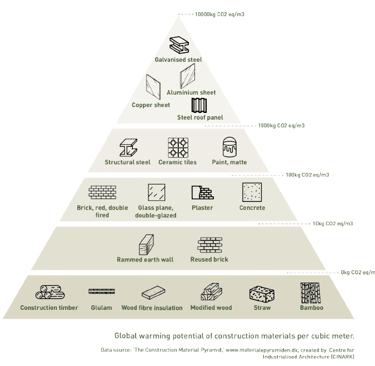
Bamboo acts as a carbon sink, absorbing CO2 at a rate three times higher than regular trees. This makes it a powerful tool to help reduce carbon emissions. Since 40% of carbon emissions come from the building industry, using bamboo as a building material offers a promising way to lower our environmental impact.
4. Fast-growing and renewable
Bamboo grows rapidly, typically reaching maturity for harvest in just three to five years. After harvesting, it regrows naturally without replanting. In contrast, trees take 30 to 50 years to fully mature. In this way, bamboo has the potential to be a sustainable alternative to timber.

5. Green steel
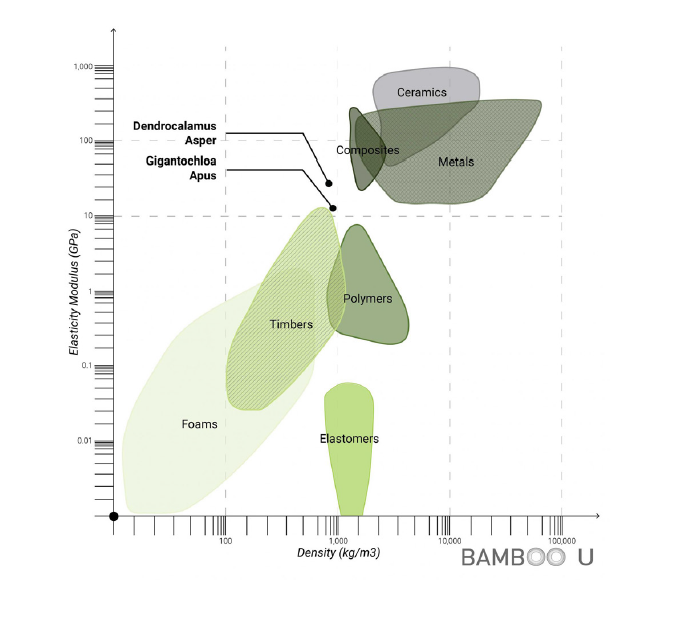
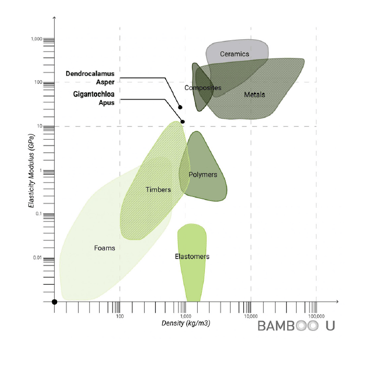
Bamboo’s unique structure, hollow stems with solid nodes, gives it remarkable strength while keeping it lightweight. Bamboo performs better than steel when the same weight of material is used to resist tensile forces. Along the length of the pole (in the direction of the fibres), bamboo also has a very high compressive strength, similar to that of cement or concrete.
6. Biodiversity enhancement
While monoculture farming often reduces biodiversity, bamboo can do the opposite when grown wisely. Its dense groves offer shelter to birds, insects, and small mammals. By growing bamboo alongside other crops, a method called agroforestry, farmers can create healthier, more diverse ecosystems that support both nature and food production.
7. Sustainable economy
Bamboo cultivation offers great economic opportunities for rural communities. It requires minimal input and little maintenance once established. Beyond its ecological benefits, bamboo supports a wide range of value-added products such as building materials, furniture, paper, pallets, activated charcoal, bioenergy, and textiles; creating diverse income streams.
8. Water conservation
Bamboo stands out for its water efficiency. With a deep root system, it taps into underground moisture and reduces dependence on surface water sources. Its wide canopy slows down rainfall, allowing more water to infiltrate the soil and recharge groundwater. Compared to traditional European crops, bamboo uses half the water to produce the same amount of dry biomass.
Once we look past the misconceptions, we discover that bamboo is not a stranger to our soil, it is a vital companion for our future. It is a material that asks us to work with nature rather than against it. By choosing the right species and the right intent, we shift from planting a forest to cultivating a legacy